

Research into pesticides is raising questions among consumers
In recent months, there has been a great deal of attention focused on pesticides in our food. A recent investigation by the food watchdog Foodwatch revealed that pesticide residues not permitted within the European Union have been found in various products from Dutch supermarkets. Pesticide residues were found in 49 of the 64 products tested, including rice, tea and herbs. In some of the products, levels were even found to exceed the legal limit.
The issue remains a topical one when it comes to fruit and vegetables too. Various studies show that pesticide residues are regularly found on certain types of fruit and vegetables. In particular, produce such as strawberries, grapes, apples and peppers often feature high on lists of crops on which multiple pesticides are found.
This raises the same question for many consumers: what can you do yourself to clean fruit and vegetables as thoroughly as possible?
Why are there pesticides on fruit and vegetables?
Pesticides are used to protect crops from insects, fungi and diseases. Within the European Union, there are strict rules governing their use and the maximum levels of residues that may remain on food.
Nevertheless, small traces may still be present on fruit and vegetables when they are on sale in shops. Although these products are safe for consumption under current regulations, many consumers choose to wash fruit and vegetables thoroughly before eating them.
What does science say about bicarbonate of soda?
The interest in washing fruit and vegetables with bicarbonate of soda – better known in the Netherlands as ‘zuiveringszout’ – isn’t just coming from social media.
In 2017, researchers at the University of Massachusetts Amherst carried out a study into various methods of removing pesticides from apples. The results were published in the scientific journal *Journal of Agricultural and Food Chemistry*.
The researchers compared three methods:
- Rinse with tap water
- Cleaning with a commonly used bleaching solution
- Cleaning with a solution of water and sodium bicarbonate (baking soda)
The study found that the baking soda solution was the most effective at reducing the levels of certain pesticides on the surface of the apples. After soaking for around 12 to 15 minutes, the pesticides under investigation had largely been removed from the skin.
The researchers also emphasised that not all pesticides can be completely removed. This is because some substances can be partially absorbed into the skin or flesh of the fruit. Consequently, no cleaning method can guarantee complete removal.
How to use bicarbonate of soda on fruit and vegetables
Do you want to wash your fruit and vegetables extra thoroughly? If so, you can use the following method:
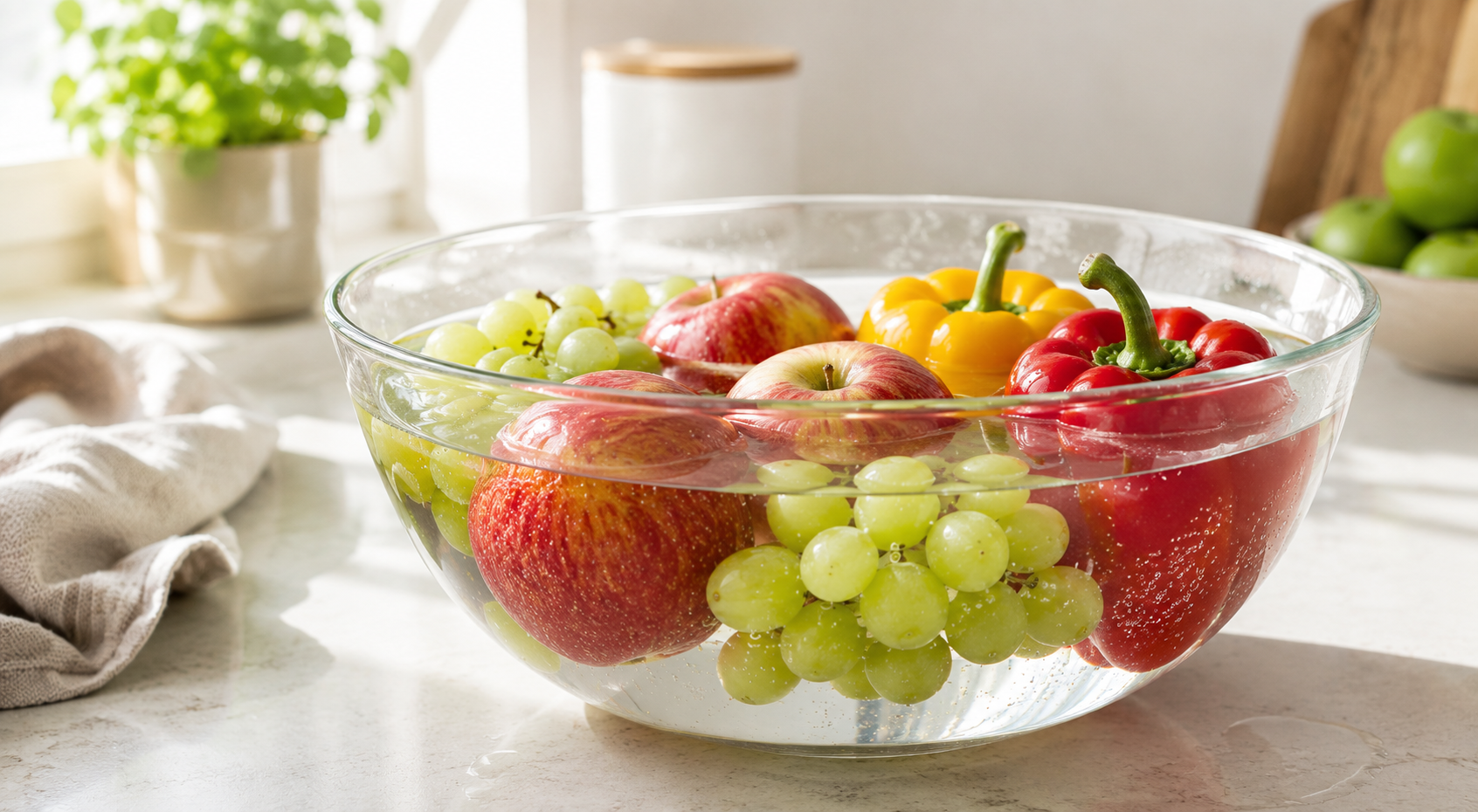
- Fill a bowl with about 1.5 litres of water.
- Add 1 tablespoon of bicarbonate of soda.
- Leave fruit or vegetables to soak for 10 to 15 minutes.
- Then rinse thoroughly with clean water.
- Leave to drain or pat dry.
This method is often used for produce that you eat with the skin on, such as apples, pears, grapes and peppers.
A simple addition to your routine
Fruit and vegetables remain an important part of a healthy diet. It is always advisable to rinse them thoroughly under running water. Anyone wishing to take extra care when washing fruit and vegetables can also opt for a solution containing bicarbonate of soda.
At a time when pesticides are regularly in the news, many consumers are looking for simple ways to be more mindful about their diet. Bicarbonate of soda is a versatile product that has been used in households for generations for a wide range of purposes.